What Grows Where – Soils and Plant Communities in the Algarve
A report on our first event of the new gardening year in 2017, an illustrated talk by Marilyn Medina Ribeiro on this important topic held onSaturday 23 September at the Municipal Library, Loulé
We learnt more about creating a beautiful garden in harmony with our soil and the plants it will support and discovered how this understanding of our soils and plant communities will help us to improve and enrich our gardens and save water.The Algarve has a Mediterranean climate – long, hot, dry summers with an average range of 20 – 30 °C, and cool, wet winters with an average minimum range of 4 – 10 °C. Its westerly location bordering the Atlantic means that the Algarve is generally wetter and windier (especially in the far west) than Mediterranean regions further east. Most plant growth ceases during the summer, with many plants surviving as dormant underground bulbs or corms until new growth is triggered by the first rains in the autumn, for example the native bulb, Paperwhite Narcissus. Winter rains usually begin in late September or early October, with showers continuing to March and April. There can long dry spells during the winter months but the first rains produce a dramatic greening of the landscape. The first spring flowers appear in late January, and from mid March to late April the flowering period reaches its peak and the region is covered in a glorious blaze of colour.

As is typical of the Mediterranean climate, frosts are
infrequent in the Algarve, allowing the extensive cultivation
of tender fruits such as Citrus and Olives. Indeed the
distribution of the frost intolerant olive (Olea
europaea), which roughly tracks the winter 7 °C isotherm
across Portugal and the rest of the Iberian Peninsula, is a
good proxy for the extent of the Mediterranean climate and
the associated flora.
Such tender crops are usually grown along the warm southern
coastal regions at lower altitude. At higher altitudes in the
Serra (over 600 m), e.g. the Monchique region, the climate is
much cooler and occasional frosts are possible. More hardy
fruits, such as cherries and plums, are grown along with
vegetables, olives and citrus being restricted to the most
sheltered valley terraces and lower slopes. Throughout the
Serra and lower hills of the Barrocal, cork oak, maritime
pine and stone pine are extensively cultivated for bark,
timber and seeds (nuts) respectively. Alongside them,
ever-increasing quantities of Australian eucalyptus are grown
principally to supply wood pulp for the paper-making
industry. The fire risks presented by extensive monocultures
of eucalyptus are the subject of national debate.
The interrelated influences of geology and climate allow the
definition of three broad geographical regions of the
Algarve: Littoral, Barrocal, and Serra, each with its own
characteristic vegetation and flora. The Littoral consists of
the coastal land running along the southern-most strip of the
region and up its western coast above the Cape St. Vincent
peninsula. It has a mixed geology of sedimentary rocks,
alluvia, and sand of relatively recent origin. Inland, the
Barrocal is an area of rolling hills, composed principally of
limestone, that increase in height upon moving north, where
they merge with the mountainous Serra. The Serra is composed
of older rocks, particularly shale and syenite, mainly
carboniferous in origin. The high (300 m) Serra is
predominantly shale with occasional igneous intrusions, most
notably the large mass of crystalline syenite at
Monchique.
Through its influence on soil, particularly soil pH, the
geology of these three regions has a significant effect on
their respective floras. Thus, the Barrocal is dominated by
plants that thrive on alkaline limestone soils, such as some
Cistus species and Lavandula luiseri, with
lime-intolerant and acid-loving plants being confined mainly
to Litoral sandy areas and shale outcrops, such as gorse
species (Ulex). By contrast the acid Serra is dominated by
plants that prefer lower pH soils, for instance Ericaceous
species such as tree heath (Erica arborea), the
strawberry tree (Arbutus unedo) and the iconic
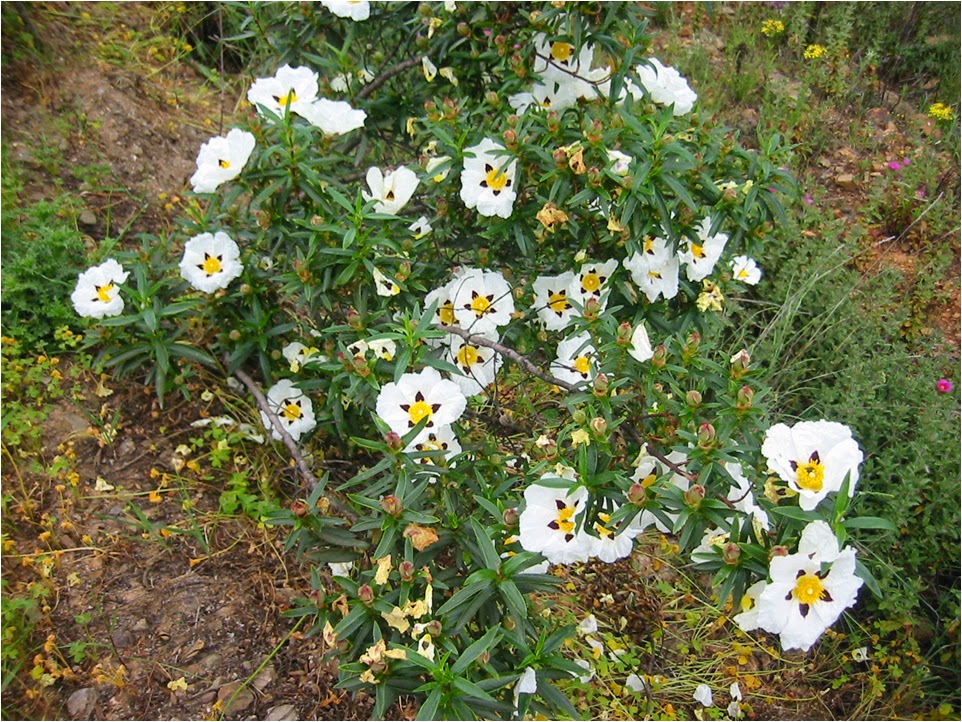
Cistus ladanifer.
|
| Cistus ladanifer |
|
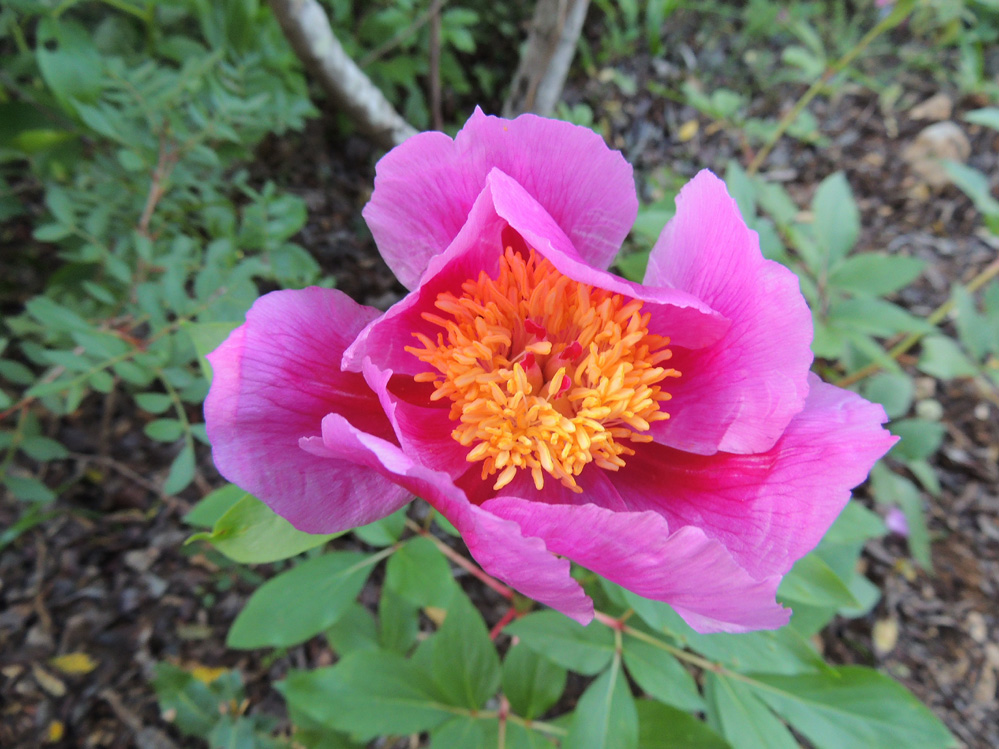
| Peony broteroi |
Rosie Peddle September 2017