Drought and the Mediterranean Garden
Ver este artigo em português – clique aqui
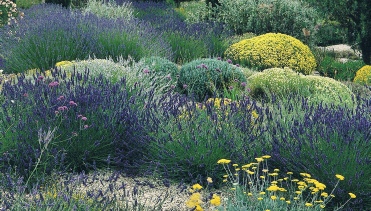
Drought has always been considered as a limitation for gardens. We have all been influenced by the temperate climate garden model, in which thriving shrubs and lush perennials surround a perfect lawn. Every month, gardening magazines make us dream of superb gardens, generally in northern Europe.
Beautiful photographs in gardening books promote an image of rustic scenes, where roses and clematis grow intertwined. Yet in areas with a mediterranean climate these ideal conditions are a dream that can never be fulfilled. Instead of gentle light we have brutal sunshine; instead of rich soil we have the stony dry soil. The drier the climate, the harder it seems to make a garden. It is as if we are engaged in a ceaseless battle against a hostile environment.
Nevertheless, dry climates offer extraordinary gardening possibilities. Paradoxically, thanks to a long tradition of a passion for gardening and botanical research, it is in England that the largest collections of drought-resistant plants have been amassed. These plants are jealously cared for as if they were precious rarities, grown in raised rock gardens to ensure perfect drainage and sometimes cultivated under glass to protect them from an excess of winter wet. Garden-lovers flock to the Royal Horticultural Society’s famous garden at Wisley, south of London, to admire a sophisticated rock garden re-created under glass. Its treasures include plants that often no one bothers even to glance at on our Mediterranean roadsides – Rhodanthemum from Morocco, Erodium from Greece or Sideritis from Turkey. While English plantsmen pride themselves on their collections of plants for dry conditions, gardeners further south are desperately watering their lawns, but achieve nothing more than a mediocre imitation of an English garden.
Rather than drought, it is often the misguided use of irrigation that limits the range of plants in mediterranean gardens. Many dry-climate plants are in fact easy to grow if we respect the conditions of their native habitat but become extremely capricious as soon as we try to water them in summer. The cistuses of the garrigue, the ceanothuses that cover the hillsides of California or the capers that billow down Sicilian cliffs quite simply cannot tolerate the combination of heat and moisture. Irrigation during our blazing summers generally proves fatal to them.
If you water your garden during the hot weather, you will never be able to grow the full range of plants adapted to the mediterranean climate. The beautiful Salvia candelabrum will be nothing more than a fantasy, the magnificent Fremontodendron covered in golden flowers won’t stand a chance. Don’t bother even to dream of the vibrant blue of Lithodora fruticosa or of the soft, silky pink flowers of Ebenus cretica: irrigation will kill them just as surely as a powerful dose of herbicide. Automatic watering systems are one of the worst inventions of the modern mediterranean gardener. You may think you are making life easier while in fact all you’re doing is limiting the range of plants that can survive in your garden. Without realizing it, you are helping to reduce the plant palette to uniformity. In region after region, gardens end up all looking much the same, having lost the individual identity that is linked to their particular climate and soil conditions.
What will happen if you stop watering? Well, yes, the plants that need water will die, one after another. So what will be left? Everyone dreads the idea of a miserable-looking garden, where dusty borders contain only a few spiny plants, and wretched shrubs eke out a meagre existence. We feel instinctively that water brings luxuriance and variety, and that dryness restricts our gardening possibilities. Yet exactly the opposite is true. Most gardeners are unaware that the natural flora of mediterranean-climate regions is a lot richer than that of temperate regions.
Planting and maintenance in the dry garden
Preparing the soil: dry climate plants have adapted to soil conditions that are rough, stony, poor and well-drained. Above all, drainage must be good. Open up compacted soils and avoid drowning your plants. Create raised beds with gravel paths between them, add small stones to the soil, provide run-off for surface water. Soil aeration should not be shallow and for large areas can be done with a tractor.
Root systems: the best criterion for choosing plants in dry gardens is the root system. Choose plants with well-developed roots grown in the new ‘smart’ pots. These are long forest-type pots that avoid the circular and knotty action of the roots seen in round pots. Look for full-bodied plants with a short branching habit.
Planting: Autumn is the best time to plant and takes advantage of the natural growth cycle of Mediterranean plants. Traditionally, the start of the gardening season comes after the first autumn rains. The aim is to stimulate the growth of the root system that will sustain the plant during the summer heat. Don’t use fertilisers that encourage unbalanced growth of the soft top. Give each plant an irrigation basin that will direct water to the roots.
Watering: watering well, usually by hand, but as infrequently as possible, every two or three weeks in the first summer should be enough for a well-prepared plant. The aim is to draw the roots into the soil.
Maintenance: open soil can attract weeds, so careful manual removal is necessary in the first few weeks. Inorganic mulches can help remove weeds and also keep soil temperatures down during the summer. Organic mulches can be used around large shrubs and trees. Be careful not to mulch close to the stems, as this can cause rotting.
Pruning: Many Mediterranean plants like to be pruned once a year: lavender, santolina, rosemary and cistus, for example. This encourages branch production and a pleasing shape. This is usually done at the end of summer in preparation for the autumn growing season. Another bonus is that shade is provided by the old flowers and seed heads.
Pests and Diseases: nowadays, the general trend is to avoid harsh chemicals and fertilisers. This is ideal for mediterranean plants with their sensitive foliage and adapted growth cycle. Increasing garden diversity will also increase insect diversity and stimulate the garden’s natural balance. Diversity will also encourage more wildlife to enter the garden and provide natural controls.
By Olivier Filippi
Olivier Filippi and his wife, Clara, run a specialised nursery in the south of France dedicated to drought-tolerant plants for dry gardens. Since the 1980s, they have travelled extensively to research mediterranean climate regions around the world. Olivier translates mediterranean landscapes into low-maintenance, drought-tolerant and pesticide-free plantings for public and private spaces.